
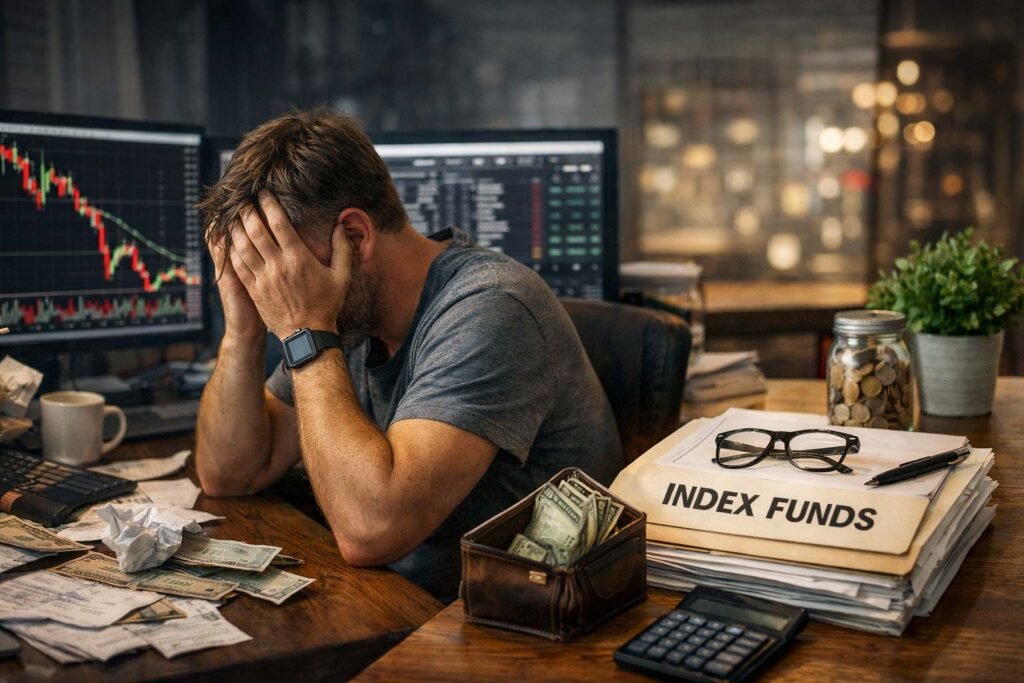
And I Did It Twice.
A True Story — With the Research, the Reality, and the Road Back
| 97% | 40% | 1% |
| of day traders lose money | of day traders quit month one | of day traders ever consistently profit |
Sources: Barber et al. (2019) | Chague et al. (2019) | FINRA | Brad Barber, UC Davis
The Setup
Every year, millions of people stare at a trading screen and make the same silent bet: that they’re smarter than the market, faster than the algorithms, and luckier than the 97% who tried before them and lost. Most of them are wrong. The market doesn’t care about your conviction. It doesn’t reward your research. And it absolutely does not hand out participation trophies.
This is the story of how a certified investment advisor — someone who studied the Canadian Securities Course, passed the exams, learned the language of markets, and spent thousands of hours staring at candlestick charts — lost his life savings day trading. And then rebuilt. And then lost it again. The second time around isn’t a plot twist. It’s the point.
By the time you finish reading this, you’ll know exactly why it happened, why it keeps happening to hundreds of thousands of people every year, and — more usefully — what the data says actually builds wealth over time. Without the screens. Without the stress. Without the $99 or $997 trading course from a 22-year-old in a rented Ferrari.
The Dream That Hollywood Built
The picture was vivid: Gordon Gekko on one phone, six monitors running, ticker tape scrolling across every screen, barking orders at some poor soul on the trading floor. The Wolf of Wall Street made it look like the most electric, morally flexible, financially insane way a person could spend their days. The lifestyle. The money. The feeling of being plugged into something that most people never even touch.
That image doesn’t leave you easily. And it didn’t leave me. So I did what any reasonable person with an unreasonable amount of ambition would do: I went all in on preparation. I studied for my Canadian Securities Course (CSC) certification. I studied for my investment advisor designation. I learned Fibonacci retracements, candlestick patterns, how to read order flow, how the USD/CAD pair responds to Bank of Canada rate decisions versus Fed moves, how GDP prints and CPI data shift sentiment in the forex market.
Technical analysis. Fundamental analysis. Macroeconomic frameworks. Currency correlations. I had the full toolkit. I was not winging it.
None of it saved me.
Because preparation assumes the game is fair. It isn’t. And that’s the thing they don’t put in the curriculum.
The Competition You Didn’t Know You Signed Up For
Here’s what doesn’t appear on page one of any trading course, certification program, or brokerage account welcome email: the moment you place a retail trade, you are not competing against other retail investors.
You’re sitting across the table from:
- Algorithmic trading systems that execute thousands of trades per second — no hesitation, no emotion, no second-guessing. They don’t get tired at 2am. They don’t revenge trade.
- High-frequency trading (HFT) firms with servers physically co-located inside the exchange building — not across town, inside the building — so their orders arrive microseconds ahead of yours. They see the same price move you see, earlier.
- Institutional investors with dedicated teams of PhD-level quantitative analysts (quants) who build proprietary models, run custom data feeds, and have capital reserves that dwarf your entire account by a factor of thousands.
- Market makers who collect the bid-ask spread on every single trade you place — winning whether you win or lose — and whose business model depends on your continued participation, not your profitability.
The market direction is set by the biggest players. And those players have already capitalized on a move before you even know the move is happening. You’re not reading the market. You’re reading yesterday’s newspaper and calling it research.
This isn’t pessimism. It’s the structural reality of modern electronic markets. And no amount of candlestick mastery changes it.
The Data They Don’t Frame and Hang on the Wall
Let’s stop talking about feelings and look at the evidence. The peer-reviewed, independently verified, brutally consistent evidence.
| Day traders who lose money | 97% | Barber et al. (2019) / Chague et al. (2019) |
| Traders who quit within one month | 40% | FINRA / MyTradingSkills |
| Still active after three years | 13% | Multiple peer-reviewed studies |
| Profitable over any five-year period | 1% | Barber et al. — less than 1% |
| Financial losses in a single year (US) | 72% | FINRA regulatory data, 2020 |
| Active traders’ annual underperformance vs index | -6.5%/yr | Brad Barber, UC Davis |
Two separate academic research teams — Barber et al. at UC Davis and Chague, De-Losso, and Giovannetti in Brazil — independently arrived at the same number: 97%. Different markets. Different methodologies. Different time periods. Same result. When two research teams working independently on separate continents land on identical findings, that’s not coincidence. That’s a conclusion.
The Brazilian study tracked nearly 20,000 individual day traders over 300 trading days. Of those who persisted for the full period, 97% lost money. Only 1.1% earned more than the Brazilian minimum wage from trading. Most gave up within 50 days.
The -6.5% annual underperformance figure from Brad Barber at UC Davis is particularly brutal. It means that on average, the active trader who thinks they’re engaged and informed is actually losing 6.5 percentage points per year relative to doing absolutely nothing — just buying a low-cost index fund and walking away. That’s not a bad month. That’s the permanent tax on showing up.
[Verified facts — Barber et al. 2019, Chague et al. 2019, FINRA, Brad Barber / UC Davis. See Sources section.]
The $99 Guru and the Art of Selling a Dream That Doesn’t Exist
Before the live trading account, there’s usually a course. Maybe more than one. There’s always someone — usually young, always confident, never quite able to explain where they actually live — who has cracked the code and is willing to share it for the low, low price of $99. Limited time. Price goes back to $997 on Monday. Results guaranteed. Screenshots of $50,000 days included.
Here’s what those screenshots actually represent: backtested results. The strategy was run against years of historical market data to find where it would have worked — in the past. It’s the trading equivalent of predicting last week’s lottery numbers. The market in 2019 is not the market in 2024. Conditions change. Algorithms adapt. The edge that looked ironclad in the backtest evaporates in live conditions.
[Expert consensus — Backtesting bias, also called curve-fitting or data-snooping bias, is a documented and extensively studied phenomenon in academic finance. See Harvey, Liu & Zhu (2016), Journal of Finance. A strategy that fits historical data perfectly is frequently one that fails in real-time forward-looking markets.]
The courses also don’t mention the paper trading problem. Most platforms hand you a simulated account loaded with $500,000 in fake money to “practice” on. Trading half a million in Monopoly dollars teaches you nothing useful about trading $10,000 of money you actually need. The mechanics might be identical. The emotional experience is completely different — and emotion is what kills accounts, not a lack of technical knowledge.
The Brain Science Behind Every Blown Account
Daniel Kahneman and Amos Tversky won the Nobel Prize in Economics for their research on how humans actually make financial decisions — not how we should, how we do. Their landmark work on loss aversion showed that the psychological pain of losing money is approximately twice as powerful as the pleasure of gaining the same amount.
Twice. That’s not a rounding error. That asymmetry rewires your decision-making in real time.
It’s why traders hold losing positions long past the point of rationality — because closing means admitting the loss is real. It’s why they take profits too early on winning trades — because the fear of giving gains back outweighs the logic of letting winners run. And it’s why, after a significant loss, they make the most dangerous decision in all of trading.
THE REVENGE TRADE
| After a painful loss, the emotional brain takes over. You’re not analyzing the market anymore — you’re trying to punish it. You want that money back, right now, and you’re going to get it by jumping back in with bigger size, lower discipline, and zero objectivity. Traders call this tilt — borrowed from poker, where it means the same thing. It’s where accounts don’t just lose. They die. |
The 3am trade is a specific version of this. You’re in a position. It’s moving against you. Logically, you know you should close it. But closing it means the loss is locked in, and your brain cannot accept that yet. So you watch. You hold. You find more analysis that confirms you’re right. And the position keeps moving the wrong way.
Finally you close it. Take the loss. Then two hours later the market does exactly what you predicted. The analysis was right. The timing and the emotional execution were catastrophic.
So you do the rational thing: you jump back in. Not because anything changed. Because you need to get that money back. Right now.
That sequence — bad trade, emotional hold, late close, revenge re-entry — is the actual mechanism that destroys most retail trading accounts. Not bad strategy. Human psychology colliding with market reality.
Five Myths the Trading Industry Needs You to Keep Believing
| “I just need the right system.” |
| There is no permanent system. By the time a pattern becomes widely known and teachable, the institutions have already identified it, exploited it, and moved on. The market adapts faster than any retail strategy can. The edge disappears the moment it’s commodified into a course. |
| “I’ll practice on a paper account first.” |
| Paper trading teaches you the mechanics. It teaches you absolutely nothing about what happens to your judgment, your breathing, and your decision-making when actual savings are at risk. The two experiences are neurologically different. |
| “Successful traders make it look easy on YouTube.” |
| Survivorship bias is the world’s most effective illusion machine. You see the 3% who succeeded — the ones who post highlight reels. You hear nothing from the 97% who quietly closed their accounts and went back to their day jobs. Social media selects for winners. It’s not a representative sample. |
| “I can do this part-time.” |
| Part-time traders face the worst structural disadvantage. The institutions monitoring your market are full-time, fully resourced, and fully automated. A retail trader checking their phone between meetings isn’t competing. They’re donating. |
| “My losses were bad luck. I almost had it.” |
| Maybe. But the 97% statistic doesn’t describe people who were this close. It describes the full distribution of people who studied, prepared, practiced, and traded — including many who were smarter and better resourced than the average retail participant. Luck doesn’t explain a 97% failure rate across two independent global studies. |
To Be Fair: Some People Do Win
Intellectual honesty requires saying this clearly: consistent, profitable day traders do exist. The research puts them at roughly 1–3% of all participants. That’s a real number. It’s not zero.
But the profile of that 1–3% looks almost nothing like the person who signs up for a $99 trading course after watching a YouTube ad. Consistent winners treat trading as a full-time professional business — not a side income stream. They operate with genuine risk capital, typically a minimum of $50,000–$100,000 CAD or USD, so they can size positions meaningfully without gambling disproportionate fractions of their account on single trades. They specialise deeply in one or two instruments rather than chasing whatever is moving this week. They follow documented, tested, rule-based money management plans — including hard stop-losses they honour without exception. And they have multi-year track records through multiple market conditions: bull runs, crashes, sideways grinding, volatility spikes.
The key question isn’t whether they exist. It’s whether that profile describes you. And if it doesn’t yet — the data suggests the odds are not in your favour.
[Credible debate — Some academic researchers argue that observed profitable retail traders largely represent statistical outliers rather than edge-based skill. The debate over whether consistent retail trading skill is real or survivorship-based remains active in financial literature.]
The Boring Strategy That Would Have Made $1.7 Million
Here’s the number that’s still hard to say out loud.
The $75,000 lost across two rounds of day trading. If that exact same money had been placed into a Vanguard S&P 500 index fund — ticker VOO — on day one, with automatic dividend reinvestment switched on, and then never touched again:
| WHAT $75,000 ACTUALLY BECOMES |
| $150,000 into Vanguard S&P 500 ETF (VOO) — never touched After 20 years: $696,893 After 30 years: $1,726,388 (~$1.7 Million) Rate used: 10.5% nominal annual average (S&P 500 historical, incl. dividends reinvested) | VOO fee: 0.03%/yr Past performance does not guarantee future results. Figures are nominal (pre-inflation). |
No trading. No analysis. No 3am positions. No courses. No gurus. No stress. Just compounding doing what compounding does when you leave it alone long enough.
The Vanguard VOO charges 0.03% per year in management fees. The average actively managed mutual fund charges 1–2% per year. That difference might sound minor. Run the numbers on $75,000 at 8% gross return over 20 years: at a 2% fee, you end up with approximately $235,000. At 0.03%, you end up with approximately $339,000 — a difference of $104,000 from fees alone, before compounding the foregone return. Fees are not a footnote. They’re a wealth transfer.
The Five-Step Framework That Actually Works
This works for Canadians. It works for Americans. It works if you’re starting with $100 or $100,000. The math is the same. The patience required is the same. The outcome — given time — is dramatically better than the alternative.
| STEP 1 — Build Your Emergency Fund First |
| Three to six months of living expenses in a liquid, accessible account — Canada: TFSA or high-interest savings account (HISA); US: High-Yield Savings Account (HYSA). This is not optional. It’s the structural foundation. Without it, you’ll liquidate investments at the worst possible moment — during a market drop, when you should be holding or buying more. |
| STEP 2 — Kill High-Interest Debt Before You Invest |
| Credit card debt at 19–25% APR is not a personal finance problem. It’s a guaranteed return when you eliminate it. No index fund, no trading account, no investment of any kind reliably beats a 22% guaranteed return on a risk-adjusted basis. Pay it off first. |
| STEP 3 — Open a Tax-Advantaged Account |
| Canada: TFSA (Tax-Free Savings Account) or RRSP through Wealthsimple, Questrade, or your bank. US: Roth IRA or 401(k) through your employer or a brokerage. Investing inside these accounts means you keep more of what you earn. The government has given you a legal mechanism to shelter your gains — use it completely before investing in taxable accounts. |
| STEP 4 — Buy a Low-Cost Index Fund and Automate It |
| Vanguard S&P 500 ETF (VOO) in the US — expense ratio: 0.03%. Vanguard FTSE All-World ETF (VT) for global diversification. In Canada, Vanguard’s VEQT or XEQT provide similar broad exposure. Set up automatic monthly contributions — even $50–$100 builds meaningful wealth through compounding. Set it, automate it, and stop looking at it. |
| STEP 5 — Stay In When It Drops — This Is the Whole Job |
| The S&P 500 has dropped significantly in every decade since its inception. The 1987 crash (-34%). The dot-com collapse (-49%). The 2008 financial crisis (-57%). The COVID crash (-34% in 33 days). Every single time, it recovered. Every single time, it reached new all-time highs. The investors who were “wiped out” were the ones who sold at the bottom. The ones who held — or bought more — got rich. Time in the market beats timing the market. Every time. No exceptions in recorded history. |
| “Wealth is not built in dramatic moments of market genius. It is built in thousands of quiet, consistent decisions made over years.” |
My 2 Sense
If day trading genuinely calls to you — if you have the capital, the discipline, the full-time commitment, and the emotional control to trade only with money you could lose completely without consequence — don’t let this stop you. Go in informed. Build a documented money management plan and follow it without exception. Master one instrument before touching another. And treat every single trade as if your plan designed it, not as if your ego needs to be right.
For the vast majority of people reading this: the simplest strategy ever devised has beaten most professional traders for most of recorded market history. It requires no certification, no software subscription, no late nights, and no course from a 22-year-old with a rented Lambo in the thumbnail.
You just have to be willing to be boring. And patient. And boring.
A smart person learns from their own mistakes. A wise person learns from someone else’s.
Consider this one on me.
| “Wealth is not built in dramatic moments of market genius. It is built in thousands of quiet, consistent decisions made over years.” |
If you made it this far, CONGRATULATIONS! Thanks for sticking around and taking time out of your day. I truly appreciate you. If you want to take control of your life and you want updates when more of my articles come out, Subscribe below and if you want to actually participate in these conversations head to my channel.
Cheers!
Adam
DISCLAIMER: This article is for educational and informational purposes only. It does not constitute financial, investment, tax, or legal advice. Always consult a qualified financial advisor before making investment decisions. Past performance is not indicative of future results.