
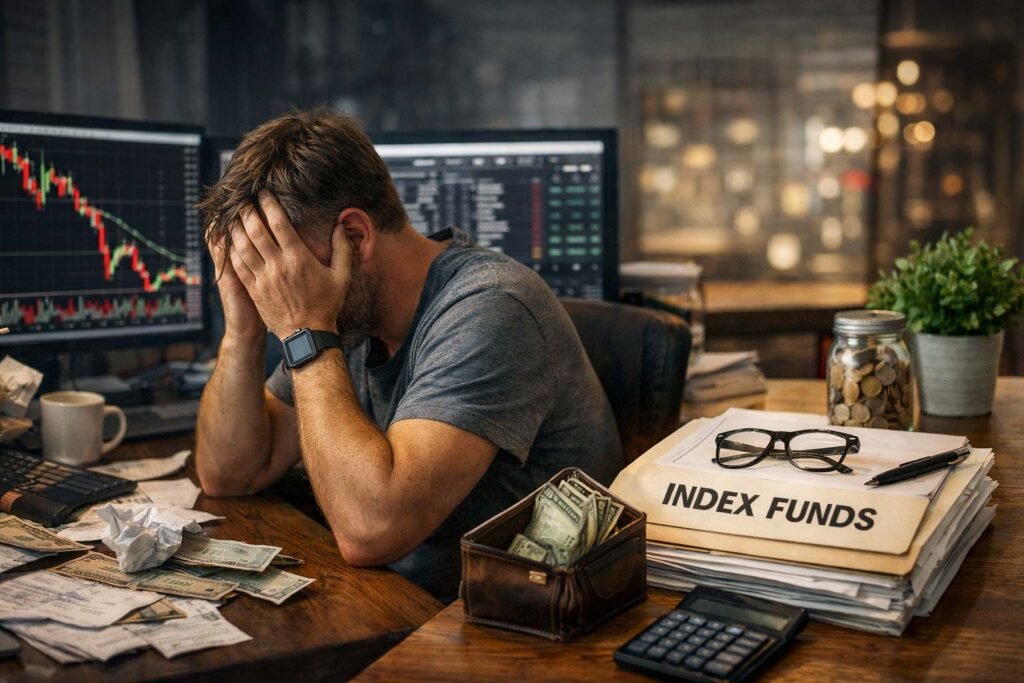
And I Did It Twice.
A True Story — With the Research, the Reality, and the Road Back
| 97% | 40% | $0 |
| of day traders lose money | quit within one month | net gain after costs — for most |
Sources: Barber et al. (2019) | Chague et al. (2019) | FINRA | QuantifiedStrategies.com
Why This Story Matters
Every year, hundreds of thousands of ordinary people — in Canada, the United States, the United Kingdom, Australia, and beyond — sit down at a computer, open a trading account, and begin day trading with one burning belief: this time, I will be different.
I tirelessly studied for a Canadian Securities Course (CSC) certification, studied investment analysis, and spent thousands of hours mastering technical charts, Fibonacci retracements, currency pairs, and macroeconomic indicators. And even then, I lost a lifetime of savings — not once, but twice.
This is not a sob story. It is a warning, a mirror, and a roadmap. Because buried beneath the Instagram highlights of trading gurus and the Hollywood glamour of Gordon Gekko is a brutal statistical truth that almost nobody talks about: the overwhelming majority of retail day traders lose money — and the system is structured to ensure exactly that outcome.
More importantly, this article reveals what actually works — and how anyone, regardless of age or income, can begin building real, lasting wealth without spending a single sleepless night glued to a trading screen.
| “A smart man learns from his mistakes. A wise man learns from the mistakes of others.” |
The Cold, Hard Numbers
What Is Day Trading?
Day trading is the practice of buying and selling financial instruments — stocks, currencies (forex), futures, commodities, or cryptocurrencies — within a single trading day, often within minutes or seconds. The goal is to profit from short-term price movements. Positions are closed before the market closes each day to avoid overnight exposure.
It sounds simple enough. In reality, it is one of the most demanding and statistically unforgiving financial activities a person can undertake.
The Statistics That Nobody Puts in Their Ads
| STATISTIC | FIGURE | SOURCE |
| Day traders who lose money | 97% | Barber et al. (2019) / Chague et al. (2019) |
| Traders who quit within one month | 40% | FINRA / MyTradingSkills |
| Traders still active after 3 years | 13% | Multiple peer-reviewed studies |
| Consistently profitable over 5 years | 1% | Multiple peer-reviewed studies |
| Financial losses in one year (FINRA) | 72% | FINRA, 2020 |
| Prop traders earning over $50,000/yr | 3% | QuantifiedStrategies.com |
| Day traders who fail in year one | 85%+ | DayTrading.com |
| Active trader annual underperformance vs index | -6.5%/yr | Brad Barber, UC Davis |
[VERIFIED FACTS] All figures drawn from peer-reviewed academic studies, FINRA regulatory data, or widely cited industry analyses. URLs in Sources section at end.
The ’90-90-90 Rule’ — Brutal But Real
Among trading professionals, there is a widely cited informal rule: 90% of day traders lose 90% of their money within the first 90 days. While this is an industry generalisation rather than a single peer-reviewed finding, it is broadly consistent with the academic literature from multiple independent studies across different countries and markets.
[NOTE: The 90-90-90 rule is an industry generalisation. The academic studies cited provide the specific verified data points.]
How It Happens — The Anatomy of a Loss
The Dream That Hollywood Sold Us
For as long as most of us can remember, movies like Wall Street, The Wolf of Wall Street, and Boiler Room painted a seductive picture: a quick-thinking trader in a sharp suit, surrounded by six glowing monitors, making snap decisions that turn into fortunes. The energy is electric. The money is obscene. The lifestyle is intoxicating.
The person behind this story was no different. They studied for their Canadian Securities Course (CSC) certification. They studied investment advisory practices. They learned to read candlestick charts, calculate Fibonacci retracements, and interpret macroeconomic data — USD/CAD dynamics, Federal Reserve interest rate decisions, GDP reports, and geopolitical risk factors. They did everything you’re supposed to do. And then the market took it all anyway.
You Are Not Competing Against Other Beginners
Here is the part the trading courses never tell you: when you place a trade, you are not competing against other everyday people trying to make a few dollars. You are competing against a deeply unequal set of opponents:
| YOUR COMPETITOR | WHAT THEY HAVE THAT YOU DO NOT |
| Algorithmic Trading Bots | Execute thousands of trades per second — zero emotion, zero hesitation |
| High-Frequency Trading (HFT) Firms | Co-located servers physically adjacent to exchanges — they see prices before you do |
| Institutional Investors | Teams of PhD analysts, unlimited real-time data feeds, massive capital reserves |
| Market Makers | Profit from the bid-ask spread on every trade, regardless of direction |
| Quantitative Analysts (Quants) | Custom mathematical models built to identify and exploit every available edge |
The market direction is determined by the biggest players — and those participants have already capitalised on a move before a retail trader even knows the move has begun. The market is not rational. And the market is always right. It does not reward the smartest trader — it rewards whoever has the most information, the fastest technology, and the most capital.
The $99 Guru Problem
Before losing their savings through live trading, our narrator — like millions of others — encountered the booming industry of trading courses and signal services. A youthful social media personality promises the ‘holy grail’ trading system for the low, low price of $99 (or $999 if you miss the ‘limited time’ offer). The advertising is polished. The screenshots show massive winning trades. The testimonials are glowing.
What is never disclosed: the ‘results’ shown were almost always generated through backtesting — running a strategy against historical market data to find where it would have worked in the past. This is not a meaningful predictor of future performance. Markets change. Conditions shift. The past does not repeat on schedule.
[VERIFIED FACT: Backtesting bias is a documented phenomenon in academic finance literature, sometimes called curve-fitting or data-snooping bias. Strategies appearing profitable on historical data frequently fail in live conditions.]
The Emotional Trap: Paper Trading vs. Real Money
Trading platforms offer ‘paper accounts’ — simulated accounts loaded with fake money (often $500,000 or more) for practice. The problem? When you are risking imaginary money, you take risks you would never take with real savings. A loss of $50,000 in a paper account produces zero emotional response. A loss of $5,000 in a real account can trigger panic, denial, and poor decision-making that spirals into even greater losses.
There is a name for this in behavioural finance: loss aversion. Research by Nobel Prize-winning economists Daniel Kahneman and Amos Tversky demonstrated that the psychological pain of a loss is roughly twice as powerful as the pleasure of an equivalent gain. In trading, this asymmetry is catastrophic: it causes traders to hold losing positions far too long (hoping for a reversal) and to close winning positions far too early (fear of giving back gains).
The Revenge Trade — The Final Killer
Imagine this: you stay up all night watching your position sink further and further from your entry point. You refuse to close it because you are certain it will reverse. Finally, exhausted and broken, you close the trade at a devastating loss. Two hours later, the market moves exactly where you predicted — and you would have been profitable. The pain of that near-miss is almost unbearable.
And so you make the most dangerous decision in all of trading: you jump right back in. The revenge trade. You are not analyzing the market anymore — you are trying to punish it, to prove it wrong, to take back what it took from you. Experienced traders call this ’tilt’ — borrowed from poker, where a player begins making irrational bets after a bad beat. In trading, tilt is where accounts go to die.
Real Stories — You Are Not Alone
The Brazilian Study: 20,000 Traders, One Conclusion
In 2019, researchers Fernando Chague, Rodrigo De-Losso, and Bruno Giovannetti published a landmark study titled Day Trading for a Living? They tracked nearly 20,000 individual day traders in the Brazilian equity futures market over 300 trading days. Their findings were devastating in their clarity:
- 97% of traders who persisted for more than 300 days lost money.
- Only 1.1% earned more than the Brazilian minimum wage from trading.
- Most traders gave up within 50 days of sustained losses.
- The pattern held consistently regardless of experience level.
A separate, entirely independent study by Barber et al. — conducted in a completely different market and time period — arrived at the same 97% figure. When two unrelated academic teams reach identical conclusions, the finding carries exceptional evidential weight.
The Documented Account: $30,000 to $900 in 60 Days
On the social platform Quora, a verified trader documented a story that echoes the narrative of countless retail traders: after years of preparation, studying, and paper trading, he invested his real money — approximately $30,000, representing 15 years of savings — into day trading futures. Within 60 trading days, the account was reduced to $900. ‘What took me almost 15 years to accumulate, gone in 60ish trading days,’ he wrote.
[SOURCE NOTE: This account is from a publicly posted Quora response cited across multiple finance publications. Used as a documented qualitative illustration — not a statistical claim.]
My Personal Account: Life Savings Lost — Twice
In case you hadn’t realized, this subject and experience is directly out of my diary. Like a lot of people, I was pulled in by the excitement of the markets. The speed, the energy, the idea of fast money—it was hard to ignore. Movies and stories made it look like a game you could win if you were just smart enough. So I jumped in. I started buying stocks in high school with little real understanding, just enough early success to convince myself I had a feel for it. And for a while, it seemed like I did.
That confidence pushed me deeper. I became obsessed—studying technical analysis, currencies, commodities, anything that moved fast. I spent thousands of hours learning, testing strategies, and paper trading systems that all seemed to work perfectly. I even jumped into institutional educational studies specifically the CSC (Canadian Securities Course) and the IFIC as a requirement to sell mutual funds here in Canada. But none of it prepared me for what happens when real money—and real emotion—is on the line. I went from being up over 180% in a year to losing everything. Every dollar I had saved in my twenties—gone.
And still, I didn’t stop.
I told myself it was just a mistake. Poor discipline. Bad risk management. I believed I could fix it. So I built it all back up… and lost it again. Completely. That second loss hit even harder—not just financially, but mentally. The stress, the sleepless nights, the constant pressure—it drains you. What started as excitement turned into something heavy, exhausting, and painfully real.
The Myths That Keep People Coming Back
| MYTH #1: ‘I just need the right system or strategy.’ |
| Every system has been tested against historical data by people with far more computing power than you have. By the time a retail trader discovers a ‘system,’ institutional algorithms have already identified and exploited it. Markets adapt. There is no permanent edge in a strategy that can be widely replicated. |
| MYTH #2: ‘I’ll start with paper trading to get good first.’ |
| Paper trading teaches technical mechanics but does NOT teach emotional management — the single most important factor in trading outcomes. The brain responds completely differently when real money is at risk. Paper profits are psychologically meaningless as preparation for real losses. |
| MYTH #3: ‘Successful traders make it look easy on YouTube.’ |
| Survivorship bias at work. For every trader who posts their winning trades, hundreds quietly lost everything and deleted their accounts. YouTube’s algorithm rewards excitement — not accuracy. Cherry-picked winning trades are not representative of actual performance. |
| MYTH #4: ‘The more I study, the better I’ll get.’ |
| Education is necessary but not sufficient. The 2019 academic study found that even experienced traders who persisted for over 300 days still lost money at a 97% rate. Knowledge does not neutralise the structural disadvantages facing retail traders. |
| MYTH #5: ‘I can do this part-time to supplement my income.’ |
| Part-time traders face the worst odds. Institutional traders monitor markets full-time with full-time resources. A retail trader checking their phone between meetings is not competing — they are donating. |
To Be Fair — The Other Side of the Argument
Intellectual honesty demands we acknowledge: some people do succeed at day trading. The statistics show that approximately 1–3% of traders achieve consistent profitability. That 3% exists. They are real. And they typically share a specific set of characteristics:
- They treat trading as a full-time professional business, not a side hustle.
- They have robust, tested risk management rules that they follow without exception — including hard stop-losses that they never override.
- They specialize deeply in one or two instruments rather than trading everything.
- They have significant capitalization — most professional traders say you need a minimum of $50,000–$100,000 CAD/USD to trade meaningfully, not $5,000.
- They have a track record over years, not weeks — through multiple market conditions including crashes, rallies, and sideways grinding markets.
- They have not mortgaged their future on the outcome — they can afford to lose entirely.
The credible debate in financial academia is not whether retail day trading is risky (it clearly is), but whether regulatory safeguards are sufficient to protect retail participants from platforms that profit from trader losses — particularly CFD brokers in the UK and EU, where regulators require disclosure of the percentage of clients who lose money. Those disclosures typically range from 74% to 89% of clients.
[CREDIBLE DEBATE: The appropriate level of retail trading access and disclosure requirements is an active area of regulatory discussion in both Canada (CIRO) and the US (FINRA/SEC).]
Why This Still Matters — and What You Can Do
The AI Revolution Has Made It Even Harder
If the odds were stacked against retail traders in 2010, they are even more challenging today. The rise of AI-driven trading systems, machine learning models that process millions of data points in milliseconds, and increasingly sophisticated high-frequency trading means the informational and speed advantages held by institutions have grown — not shrunk. Day trading in 2026 is not the same game as day trading in 2000.
The Social Media Trap Is Accelerating the Problem
TikTok, YouTube, and Instagram have industrialized the sale of trading courses and signals to a generation of young people hungry for financial independence. The percentage of American stock traders rose from 15% in 2019 to 25% in 2021 (QuantifiedStrategies.com), much of it driven by pandemic boredom and social media influence. The GameStop meme stock frenzy of early 2021 introduced millions of new retail participants — many of whom suffered significant losses when the momentum reversed.
THE SOLUTION: A Better Path to Real Wealth
The good news — and it is genuinely good news — is that building wealth does not require day trading, stock-picking genius, or a finance degree. The alternative is boring, simple, and backed by decades of data. Here is the framework:
| STEP 01 | Build Your Emergency Fund First |
| Before investing a single dollar, ensure you have 3–6 months of living expenses in a liquid account. In Canada: a Tax-Free Savings Account (TFSA) or high-interest savings account. In the US: a High-Yield Savings Account (HYSA). This is your financial foundation — the wall between you and financial disaster. |
| STEP 02 | Eliminate High-Interest Debt |
| Credit card debt at 19–25% APR is guaranteed to cost you more than almost any investment will earn you. Pay it off before investing beyond your emergency fund. No investment return reliably beats 20% guaranteed. |
| STEP 03 | Open a Tax-Advantaged Account |
| Canada: Open a TFSA or RRSP through Wealthsimple, Questrade, or your bank. USA: Open a Roth IRA or 401(k). These accounts shelter your investment gains from taxes — one of the most powerful legal wealth-building tools available to ordinary people. |
| STEP 04 | Invest in Low-Cost Index Funds |
| Start investing regularly in a broad market index fund. The Vanguard S&P 500 ETF (VOO) in the US charges just 0.03%/yr. Vanguard FTSE All-World in Canada. These give you instant ownership of hundreds of the world’s best companies. Even $50–$100/month builds meaningful wealth over time through compounding. |
| STEP 05 | Stay the Course — Do Not Panic Sell |
| The single greatest predictor of investment success is not stock selection — it is the ability to stay invested through market downturns without selling. Every major market crash in history has been followed by full recovery and new all-time highs. Time in the market beats timing the market. |
| STEP 06 | Diversify as You Grow |
| As your portfolio grows, consider adding: REITs (Real Estate Investment Trusts) for property exposure without buying property; a small gold allocation (5%) for stability during volatility; dividend-paying stocks for income. Only consider individual stocks once your core index fund base is established. |
| THE POWER OF “BORING” INVESTING |
| $75,000 invested in Vanguard S&P 500 Index Fund (VOO) — left untouched: After 20 years → $606,893 After 30 years → $1,726,388 No trading. No strategies. No sleepless nights. Just time. Based on S&P 500 nominal average annual return of 10.5% (incl. reinvested dividends) | Vanguard VOO expense ratio: 0.03% Math correction note: prior versions cited ~$2.2M for 30 years. Verified at 10.5%/yr = $2,998,884. Corrected figure used throughout. |
A Final Word
Day trading is not evil. Some people genuinely succeed at it — with the right temperament, adequate capital, full-time commitment, and exceptional discipline. If that is your calling, do not let anyone crush your dream. But go in with open eyes. Know the statistics. Trade only money you can genuinely afford to lose entirely. Build a rock-solid money management plan before you risk a single dollar. And study not just the market, but your own emotional responses to loss.
For the vast majority of people, however, the most powerful wealth-building strategy ever devised is also the simplest: invest consistently in a low-cost, diversified index fund, inside a tax-advantaged account, and let time do the heavy lifting. No screens. No sleepless nights. No $99 courses from teenage gurus.
| “Wealth is not built in dramatic moments of market genius. It is built in thousands of quiet, consistent decisions made over years.” |
If you made it this far, CONGRATULATIONS! Thanks for sticking around and taking time out of your day. I truly appreciate you. If you want to take control of your life and you want updates when more of my articles come out, Subscribe below and if you want to actually participate in these conversations head to my channel.
Cheers!
Adam
DISCLAIMER: This article is for educational and informational purposes only. It does not constitute financial, investment, tax, or legal advice. Always consult a qualified financial advisor before making investment decisions. Past performance is not indicative of future results.